
PlanetHoster Review: My Experience
PlanetHoster caught my attention because it is doing more than selling a Canadian landing page. The company is based in Laval, operates its own AS53589 network and lets customers choose Canadian hosting in Quebec. I also manage a HybridCloud server for a client, which gives me firsthand experience with the N0C panel and its managed infrastructure.
Quebec businesses, WordPress and WooCommerce sites, agencies and teams that want Canadian data location
Own AS53589 network, isolated Web Projects, N0C management and in-house bilingual support
N0C is different from cPanel, and PlanetHoster's Web Project pricing model takes a little time to understand
"PlanetHoster makes the strongest case when you care about who runs the network, where the data lives and whether the platform can scale beyond a basic shared hosting account."
-
Quebec roots and Canadian ownership
PlanetHoster has operated since 2007 and is headquartered in Laval, Quebec. It describes itself as privately owned and manages its own infrastructure, network, software, security and support.
-
The infrastructure is the differentiator
PlanetHoster owns AS53589 and says it uses its own long-haul waves and metro fibre in certain locations. That gives it more control over the network than a straightforward white-label hosting reseller.
-
The World is not traditional shared hosting
Standard, Plus and Ultra are built around isolated Web Projects with NVMe storage, Redis, Memcached, N0C Storage and 45-day backups. Ultra adds semi-dedicated priority resources and LiteSpeed Enterprise.
-
Where I would look elsewhere
If cPanel is a hard requirement, if you only care about the cheapest introductory price, or if you want an unmanaged developer cloud with raw root access from day one, PlanetHoster may not be the best fit.
PlanetHoster's Quebec Roots
PlanetHoster is headquartered in Laval, just north of Montreal, and has operated since 2007. That matters here because this review is specifically about Canadian hosting, not simply a global host with a Canada-focused page.
The company is also an accredited registrar with organizations including ICANN, CIRA and AFNIC. For a business that wants to keep domains, DNS, SSL and hosting with one provider, that can simplify day-to-day management.
Quebec businesses also get a practical benefit from French-language support and a local Canadian hosting option. Those points are more useful to me than generic claims about being "local."
Canadian Data Location: Montreal, Paris and Lausanne
Another reason PlanetHoster stands out is its infrastructure footprint. PlanetHoster operates across data centres in Canada, France, and Switzerland, including a Montreal data centre located in Quebec. The Montreal facility is described as a Tier III+ data centre with direct connectivity to North America.
For a Canadian audience, the Montreal location can reduce network distance compared with hosting the same workload overseas. It also gives businesses a clear Canadian option when data location matters to procurement, contracts or internal privacy policies.
Data location is only one piece of privacy compliance. You still need to understand where backups are stored, which vendors can access the data and how your own application collects and processes personal information.
Choose Your Data Centre at Subscription
PlanetHoster lists certified facilities across the three regions and connects them through its own network. The company currently advertises roughly 69 ms between Paris and Montreal.
Choosing the Montreal location can make Canadian data-residency planning simpler, but it does not make a business automatically compliant with PIPEDA or Quebec Law 25. I cover the broader privacy side in my PIPEDA and Canadian privacy guide.
24/7 Support in English and French
Hosting support is one of those things that only matters when it really matters. When a site goes down, an email account breaks, a DNS record is wrong, or a migration gets messy, I don't want to be stuck with generic responses from someone reading a script. I want support from people who actually understand the platform.
PlanetHoster says its technical support is handled in-house, with 24/7 availability, ticket, phone, and documentation support, a response time under 15 minutes, and French-speaking support available seven days a week.
PlanetHoster advertises an average ticket response below 15 minutes. Trustpilot currently shows a 4.7/5 score from more than 5,400 reviews, with recent reviews frequently mentioning fast support and migration help.
View PlanetHoster's current Trustpilot profile.
That's a big deal for Quebec businesses and bilingual Canadian teams. A lot of hosting companies technically "support Canada," but they don't really support the Canadian bilingual market.
PlanetHoster's French-first and English-friendly support model makes it a much better fit for businesses in Quebec, francophone organizations, and companies that need to serve both English and French users.
Security Features Built Into the Platform
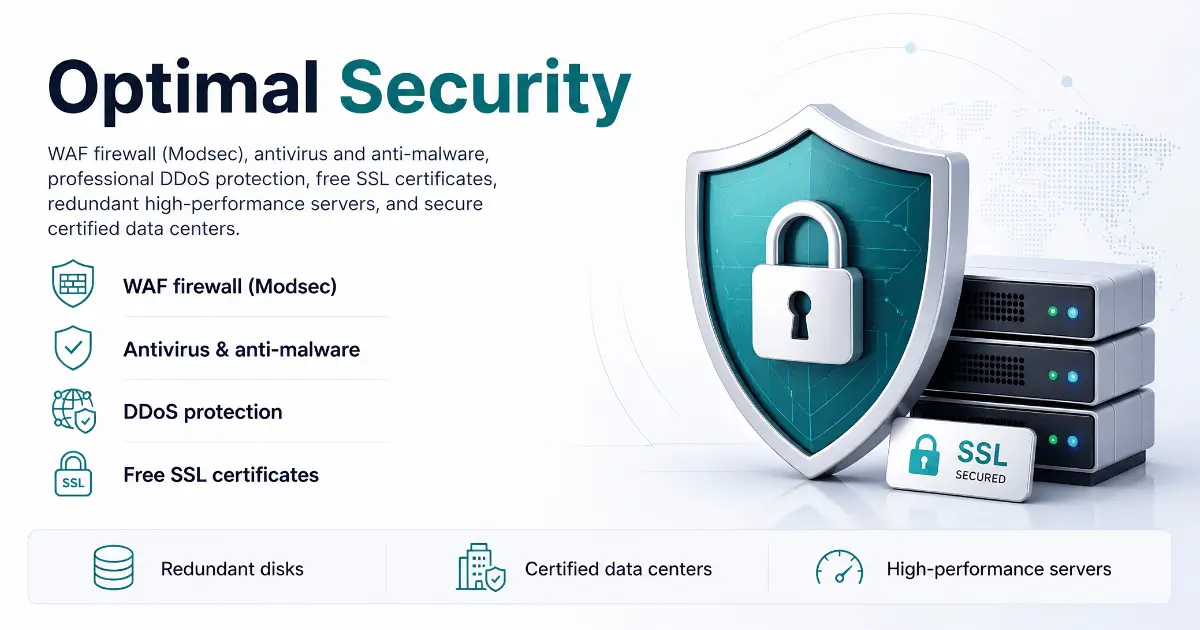
I don't want to spend my weekends worrying about a site getting hacked or knocked offline by a botnet. PlanetHoster handles most of the heavy lifting on the security side, and that's a real comfort once you've actually had to deal with a compromised site before.
Security Features That Actually Stand Out
These run quietly behind every plan. You shouldn't have to configure them, and most users never have to think about them:
- 🛡️ WAF Pro & Anti-Spam: keeps junk out of comments, contact forms, and inboxes
- 🔐 Two-Factor Authentication: the hosting account itself stays locked down
- ⚡ L4 + L7 DDoS Protection: comprehensive coverage at both network layers
- 🏢 Tier III & Tier IV Facilities: physical security and redundancy at the building level
- 📋 ISO 9001, ISO 50001, ISAE 3402: operational and quality certifications
- 💳 PCI-DSS certified facilities: useful infrastructure for payment workloads, but not a complete compliance program by itself
These are useful infrastructure controls, especially for e-commerce, but your own application, payment flow, access controls and policies still determine whether the full environment meets its compliance obligations.
PlanetHoster's Own Network: AS53589
One of PlanetHoster's strongest technical differentiators is that it owns the AS53589 network rather than presenting itself only as a hosting storefront. Its network documentation describes N+N redundancy, several hundred Gbps of capacity, Anycast DNS and its own fibre infrastructure in parts of the network.
- AS53589: PlanetHoster's own autonomous system and IP network
- Long-haul waves and metro fibre: PlanetHoster says it operates its own links in certain locations
- Anycast DNS: routes DNS requests through distributed network points
- Anti-DDoS: protection is integrated at the network and application layers
Owning an ASN does not automatically make a host faster than every reseller, but it is a useful sign that PlanetHoster has invested deeper in the infrastructure stack than a basic white-label provider.
- Run a Quebec or Canadian business and want a Quebec-rooted host
- Need 24/7 in-house support with French and English service
- Care about certified data-centre facilities and Canadian data-location options
- Want domain registration, DNS, and hosting under one accredited provider
- Need a clear upgrade path from shared to HybridCloud dedicated
- Value a provider that publishes renewable-energy and data-centre efficiency metrics
- Just want the absolute lowest entry-level promo price you can find
- Need cPanel specifically and aren't open to learning N0C
- Don't need any Canadian or Quebec data residency story
- Want a developer-first cloud platform with full root over standard plans
Hosting Plans
PlanetHoster's lineup makes more sense once you split it into two layers. The World handles Standard, Plus and Ultra Web Projects, while HybridCloud is the managed dedicated step up for heavier workloads.
The prices shown here were captured in Canadian dollars during this review. PlanetHoster changes promotions and term discounts, so check the current checkout price and renewal terms before ordering.
The World Ecosystem: Shared + Semi-Dedicated
The World is built around isolated Web Projects rather than placing every site in one traditional shared account. Each project has its own allocated environment, which helps separate resource usage and security issues between sites.
PlanetHoster calls this hermetic isolation. For agencies or anyone hosting several unrelated sites, that separation is one of the more useful parts of the platform.
There are three main Web Project tiers:
Web Project Standard
The foundation tier and the right starting point for most personal sites, portfolios, small business pages, and lightweight web apps.
Everything is built on premium NVMe/SSD storage that's triple-redundant, and you get N0C external cloud space included for backups out of the box.
For a typical 5-page business site or blog, this is more than enough. I'd happily put a personal portfolio or a small consultancy site on this tier without overthinking it.
- 10 GB NVMe/SSD (3x redundant)
- 50 GB N0C Storage (S3) for backups
- Hermetic project isolation
- Unlimited pro emails
- PHP, Node.js, Python, Ruby
- Free SSL + Pro WAF + 45-day backups
- Dedicated Redis & Memcached
- Unlimited subdomains & databases
PlanetHoster regularly uses longer-term launch pricing. Compare the promotional term with the regular renewal cost instead of judging the plan only by the lowest monthly number on the order page.
PHA-hostfinder at checkout for 15% off
Web Project Plus
The growth-stage upgrade.
Storage jumps 5x to 50 GB dedicated NVMe/SSD, processing capacity (CPU and RAM) gets a real boost, and the SLA bumps to an advertised average availability of 99.99%.
That's where it starts feeling enterprise-grade rather than entry-level.
The native WordPress AI assistant is a nice extra if you want to spin up a polished site in minutes without picking themes manually.
This is where I'd point most growing small business sites. The storage jump alone earns it once you have a real WordPress installation with images and media.
- 50 GB NVMe/SSD (Premium N+N)
- 250 GB N0C Storage (S3)
- Boosted CPU & RAM headroom
- 99.99% advertised average availability
- WordPress AI launch assistant
- Free SSL + Pro WAF
- 45-day externalized backups
- Unlimited pro emails & databases
Plus is the tier I'd look at for a growing WordPress or business site that needs more storage and processing headroom. Standard can still be enough for lighter sites, so there is no reason to overbuy.
PHA-hostfinder at checkout for 15% off
Web Project Ultra
This is where things get serious.
Ultra is semi-dedicated territory built specifically for demanding e-commerce (Magento, WooCommerce, PrestaShop) and critical SaaS apps.
You get 100 GB NVMe storage, exclusive LiteSpeed Enterprise with LSCache and LiteMage, and the standout feature: Auto Peak Power, which automatically multiplies your RAM and CPU by 2.5x during traffic spikes.
If you've ever lost a Black Friday because your shared host couldn't keep up with the surge, you'll understand why that feature alone can pay for the upgrade.
VIP 24/7 priority support and on-demand snapshot restoration round it out.
- 100 GB NVMe (3x redundant)
- 500 GB N0C Storage (S3)
- LiteSpeed Enterprise + LSCache + LiteMage
- Auto Peak Power (2.5x RAM/CPU on demand)
- 99.99% advertised average availability
- VIP 24/7 priority support
- On-demand snapshots & granular restore
- Magento / WooCommerce / PrestaShop ready
Ultra makes sense when the site can actually use its priority resources, LiteSpeed Enterprise or traffic-spike capacity. For a normal brochure site, Standard or Plus is the more sensible buy.
PHA-hostfinder at checkout for 15% off
HybridCloud Server: 100% Managed Dedicated
When you outgrow shared (even semi-dedicated), HybridCloud is where you go.
PlanetHoster currently advertises HybridCloud from C$59/month. You get an entire dedicated cloud server. The kicker is that it's 100% managed by their team.
All the brute force of dedicated hardware without needing a sysadmin on staff to keep it running safely.
HybridCloud Server
I currently manage a HybridCloud server for a client and the part that surprised me most is how hands-off it actually feels.
You get full control through the N0C panel, CLI, and API, but the heavy lifting (patches, hardware, security baseline) stays on PlanetHoster's side.
It bridges the gap between raw dedicated power and a UI you'd be comfortable handing to a non-technical site owner.
All of The World's features (WordPress AI, business email, SSL, WAF Pro) carry over to HybridCloud, just running on dedicated hardware that's all yours.
- Up to 32 dedicated CPU cores
- Up to 128 GB dedicated RAM
- Up to 16 TB premium NVMe/SSD
- Hundreds of projects, no project limits
- Premium connectivity at hundreds of Gbps
- Hardware-level anti-DDoS
- API/CLI + native CI/CD
- 99.90% contractual SLA listed by PlanetHoster
- HTTP/3, PHP, Node.js, RoR, Python
- CloudLinux OS + KernelCare live patching
- WAF Atomicorp at the edge
- N0C control panel, audited via Bugcrowd
- Agile in-house management team
- High availability: redundancy + instant restart
- Zero commercial limits, no hidden fees
- Deep access to server-level settings
HybridCloud only really makes sense once you've actually outgrown semi-dedicated, or when your traffic patterns demand consistent dedicated horsepower. For most readers, Standard, Plus, or Ultra is the right pick. But knowing this upgrade path exists, with the same provider and the same control panel, is useful.
PHA-hostfinder at checkout for 15% off
Quick Comparison: Which PlanetHoster Plan Fits You?
For a basic site, you don't need Ultra or HybridCloud.
For a growing WooCommerce store, compare Plus and Ultra based on traffic, catalog size and whether you need the semi-dedicated resource priority.
The trick is matching the plan to the actual workload, not picking the cheapest tier and hoping.
| Plan | Starts At | Best For |
|---|---|---|
| Web Project Standard | C$13.18/mo | Portfolios, brochure sites, lightweight personal projects |
| Web Project Plus | C$21.43/mo | Growing WordPress sites, small business sites with media |
| Web Project Ultra | C$32.98/mo | WooCommerce, Magento, PrestaShop, critical SaaS apps |
| HybridCloud Server | From C$59/mo | High-traffic sites, agencies running hundreds of projects, dedicated workloads |
The World vs HybridCloud: Two Complementary Architectures
One thing worth understanding before you pick a tier.
The World and HybridCloud aren't really competing. They solve fundamentally different problems.
The World: Resilience via Dispersion
Each Web Project is isolated from the others and can be assigned to the region you choose. For multi-project portfolios, that lets you spread workloads across separate infrastructure instead of tying every site to one shared account.
The practical advantage is fault isolation. A problem affecting one project or physical host does not automatically mean every project in your account goes down with it.
HybridCloud: Power via Centralization
Solves the opposite problem. You want raw computing power for heavy workloads. HybridCloud allocates an entire dedicated server to you, and 50 projects placed on it all benefit from immediate access to a unified pool of CPU and RAM.
The trade-off is concentration: a dedicated server centralizes more of your workload on one environment. If your architecture needs additional redundancy, design that at the application and infrastructure level.
My Final Take on PlanetHoster's Lineup
The lineup is refreshingly easy to navigate once you understand the two-track philosophy.
For most Canadian small businesses and WordPress sites, Standard or Plus is the right starting point.
Ultra is where I'd go the moment you're running a real e-commerce store or any SaaS app with paying customers.
HybridCloud only makes sense once you've clearly outgrown semi-dedicated.
The 60-day money-back guarantee gives you real room to test before committing. It gives you more time to test the platform before making a long-term decision.
What I Like About PlanetHoster
"The strongest part of PlanetHoster is not a single feature. It is the fact that the network, control panel, hosting platform and support are all closely tied together instead of feeling like unrelated products."
What Has Stood Out in My Use
I currently manage a HybridCloud server for a client. The biggest practical advantage has been the managed side of the service: I still get useful control through N0C, while PlanetHoster handles much of the server maintenance and platform work that would otherwise need a sysadmin.
- The infrastructure is verifiable. AS53589, Canadian hosting, network documentation and data-centre information are all public.
- N0C is integrated across the platform. Domains, email, databases, SSL, backups and Web Projects are managed from the same system.
- The World has clear upgrade steps. Standard, Plus and Ultra solve different workload sizes without forcing an immediate move to a dedicated server.
- Support is in-house. PlanetHoster publishes a sub-15-minute average response time, and its large Trustpilot footprint is heavily weighted toward support feedback.
- The Montreal option matters. Quebec businesses can keep supported workloads in Canada and get French-language support from the same provider.
What I'd Watch Out For
- N0C is not cPanel. If you know cPanel by muscle memory, expect a learning curve before the workflow feels natural.
- Pricing takes a minute to understand. Web Projects, packs, term discounts and promotions are different from a simple one-plan shared-hosting model.
- HybridCloud is unnecessary for most small sites. The managed dedicated product is excellent when you need it, but Standard or Plus is enough for many normal business websites.
- Some performance numbers are PlanetHoster benchmarks. Treat vendor benchmarks as useful context, not a guarantee that every WordPress site will hit the same result.
PlanetHoster is one of the stronger Quebec-based hosts I have reviewed, especially if you value local infrastructure, French-language support and more control over where your workloads run.
People often ask me about PlanetHoster vs Web Hosting Canada (WHC), because both are established Canadian options. WHC is easier to understand if you want a traditional mix of cPanel hosting, domains and business email. PlanetHoster is more distinctive if you want isolated Web Projects, N0C, its own network and a direct path into managed HybridCloud.
A Real Network, Not Just Rented Space
PlanetHoster also stands out because it operates AS53589 and publishes details about its Anycast DNS, network capacity, anti-DDoS protection, long-haul waves and metro fibre in certain locations.
That is a much deeper infrastructure footprint than I would expect from a basic white-label host.
It does not guarantee perfect performance, but it gives PlanetHoster more control over routing and network operations than a provider that relies entirely on an upstream platform.
PlanetHoster's current site says more than 500,000 websites are hosted on its infrastructure. Scale by itself does not prove quality, but it does show that this is a mature platform rather than a small reseller operation with a handful of servers.
Is PlanetHoster Right For You?
PlanetHoster is one of the more interesting Canadian options when infrastructure, data location and support matter more than chasing the lowest introductory price.
It's an especially appealing choice if you want:
- A Canadian hosting provider you can compare with the rest of my directory
- A company based directly in Quebec
- Local Canadian and Quebec data centre options
- Expert support in both French and English
- Strong, granular control over your infrastructure
- Enterprise-grade built-in security features
- Domain registration and hosting under one provider
- A platform that grows from a small business site to serious infrastructure
PlanetHoster may not be the right fit if you only want the absolute cheapest hosting plan available.
But for Canadian small businesses, Quebec companies, digital agencies, ecommerce stores, and privacy-conscious organizations, it deserves a serious look.
My PlanetHoster Verdict
PlanetHoster is a strong fit for Canadian and Quebec businesses that care about data location, in-house support and a hosting provider that operates deeper into the network and infrastructure stack.
The biggest trade-off is familiarity. N0C and the Web Project model are different from the cPanel hosting many people already know. If that does not bother you, the platform offers a useful path from a normal WordPress site to semi-dedicated hosting and managed HybridCloud without changing providers.
Frequently Asked Questions About PlanetHoster
Common questions about PlanetHoster. About the company, picking the right plan, getting started, and whether it's the right fit for your project. Tap any question to expand the answer.
01 Is PlanetHoster a Canadian web hosting company?
Yes. PlanetHoster is a Canadian-owned hosting company headquartered in Laval, Quebec, in the greater Montreal region, and has been operating since 2007.
For me, this is one of the biggest reasons PlanetHoster stands out from the dozens of generic hosting brands that just market to Canadians without the same local roots.
What I like even more is that PlanetHoster manages its own infrastructure, network, software, security, and support in-house. That matters because I want a hosting provider with real operational control, not a reseller stacking discounts on top of someone else's backend.
02 Where are PlanetHoster's data centres located?
PlanetHoster operates infrastructure across data centres in Canada, France, and Switzerland. For Canadian businesses, the most important detail is that PlanetHoster offers a Montreal data centre right in Quebec, with direct North American connectivity.
That gives Canadian and Quebec businesses a stronger local hosting option if they care about site performance, data location, and keeping infrastructure closer to their customers.
You can also choose between Europe or Canada/Quebec as your hosting location at signup, which is useful for businesses with international audiences.
03 Is PlanetHoster good for Quebec businesses?
Yes. PlanetHoster is one of the strongest options I'd point a Quebec business toward.
The company is based in Laval, has Canadian and Quebec data centre options, and offers French-language support seven days a week. None of that is bolted on as an afterthought.
For Quebec businesses that care about French-language support, Canadian privacy expectations, data location, and working with a provider that actually understands the Quebec market, PlanetHoster fits naturally.
04 Which PlanetHoster plan should I choose?
It depends on how much power and control your website needs. Here's how I'd actually break it down:
- Web Project Standard or Plus: the right starting point for most small business sites, blogs, portfolios, and standard WordPress sites. You get isolated projects, NVMe/SSD storage, professional email, security features, backups, and the N0C control panel.
- Web Project Ultra: the better fit for higher-traffic WordPress sites, WooCommerce stores, and critical SaaS apps that need semi-dedicated power and Auto Peak Power for traffic spikes.
- VPS Hosting: for users who need more isolation and scalable resources but don't yet need a full dedicated server.
- HybridCloud Server: the managed dedicated server option with fully dedicated CPU, RAM, and storage. The right pick for agencies managing heavy client work or businesses with consistent dedicated workloads.
Start on Standard or Plus unless you already know you need more. Most Canadian small business sites never need to leave The World ecosystem.
05 Is PlanetHoster good for WordPress and WooCommerce?
Yes. PlanetHoster can be a good fit for both WordPress and WooCommerce, especially if you want Canadian or Quebec hosting with performance features that go beyond basic shared hosting.
For a blog or showcase WordPress site, the Web Project Standard plan is enough. For higher-traffic WordPress sites or WooCommerce stores, Web Project Ultra is the better pick.
Ultra includes LiteSpeed Enterprise with LSCache and LiteMage, priority resources, and Auto Peak Power for traffic spikes. That combination is what makes it appealing for ecommerce stores, product launches, busy sales periods, and any WordPress site where downtime hurts revenue.
06 Is PlanetHoster PIPEDA or Law 25 compliant?
PlanetHoster can help Canadian and Quebec businesses make better hosting choices around data location, privacy, and infrastructure control. But no web host automatically makes a business PIPEDA or Law 25 compliant on its own.
What I like is that PlanetHoster gives businesses clearer Canadian and Quebec hosting options. You can choose Canada/Quebec as your hosting location, and PlanetHoster highlights digital sovereignty, certified data centres, externalized backups, DDoS protection, and in-house infrastructure management.
For actual compliance, you still need to review the details. Where is your website hosted? Where are backups stored? Who has access to support data? What contractual terms apply, and does your business need a privacy impact assessment?
PlanetHoster gives you a stronger local starting point, but compliance is still your responsibility as the business owner.
07 What is PlanetHoster's N0C control panel?
N0C is PlanetHoster's proprietary in-house control panel. They built it themselves and maintain it themselves, which means it isn't a generic cPanel skin running on top of someone else's stack.
You manage emails, MySQL databases, domains, DNS, SSL certificates, FTP accounts, and multi-domain configurations from one secure interface. It's also mobile-friendly across iPhone, iPad, and Android.
If you've spent years on cPanel, there's a small learning curve. But N0C is lighter, faster, and gets audited externally through Bugcrowd. After the first week of using it, I find it easier to work with than cPanel for most day-to-day tasks.
08 Does PlanetHoster offer a money-back guarantee?
Yes. PlanetHoster offers a 60-day satisfaction guarantee on all hosting plans. If you decide the service doesn't work for you, you can request a full refund (excluding the domain name) by contacting support.
That gives you a useful amount of time to test the platform after migration.
It gives you real time to migrate over, run your site through a few weekly cycles, and decide whether PlanetHoster fits, without rushing the decision.