
A website can have a .ca domain, be owned by a Canadian business, run on a US-owned hosting company, bill in USD, and store customer data outside Canada.
That is the problem.
So, what makes a website truly Canadian? As a Canadian developer, I do not judge that by the domain extension alone. I look at the full picture: the domain, the business behind the site, the hosting company, the server location, the billing currency, and where customer data actually lives.
A .ca domain is a good Canadian signal, but it is only one layer. CIRA requires .ca registrants to meet Canadian Presence Requirements, which means the registrant must show a connection to Canada. It does not automatically prove the website is hosted in Canada, owned by a Canadian hosting company, or billed in Canadian dollars.
That distinction matters. Especially if you care about Canadian data residency, PIPEDA due diligence, support from a Canadian company, and avoiding surprise USD exchange rates.
What Makes a Website Truly Canadian?
A website is truly Canadian when the domain, business ownership, hosting provider, server infrastructure, support operations, and billing model all have a real Canadian connection. A .ca domain helps signal a Canadian presence, but it does not prove the website is hosted in Canada or powered by a Canadian-owned company.
The Domain
A .ca domain controlled by CIRA. Proves the registrant meets Canadian Presence Requirements, but reveals nothing about hosting or ownership.
The Business
Who owns the website? A Canadian citizen, permanent resident, or Canadian-incorporated company headquartered in Canada and paying Canadian taxes.
The Host
The hosting company is Canadian-owned and operated, not a US firm with a "Canadian region" option. Billing in CAD. Support from real Canadians.
The Server
The actual physical metal where files, databases, and backups live. Only when this sits on Canadian soil is your customer data protected exclusively by PIPEDA.
All four layers can be Canadian. All four can be foreign. They are completely independent. Most "Canadian" websites pass only the first one.
Test Your Site With Our Canadian Validator
Below is a free tool I built specifically for this article. Set the four dropdowns to match your own website, then look at the score. A real Canadian website hits 100%. Anything less means at least one layer is foreign.
Truly Canadian Website Validator
Is your digital presence actually on home soil?
Calculating...
A 100% score requires data sovereignty: Canadian owned and Canadian hosted.
Two Canadian Hosts That Pass Every Layer
If you ran your own website through the validator and didn't hit 100%, here are two hosts I personally evaluated that pass all four Canadian layers: Canadian-owned, Canadian-operated, Canadian servers, and CAD billing.
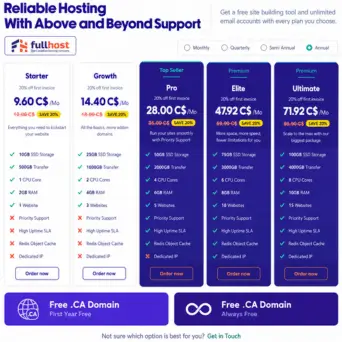
FullHost
Victoria, BC-based. Canadian-owned and operated since 2004. Servers strictly on Canadian soil. CAD billing. Includes a Canadian-built website builder with e-commerce.
Visit FullHost →
Web Hosting Canada
Montreal-based, in business since 2003. Data centres in Montreal and Vancouver. Bilingual support. CAD billing. Among the most affordable genuinely-Canadian providers.
Visit WHC →The "Canadian" Factor Cheat Sheet
Here is the same idea broken down as a reference table. Most signals that look Canadian are about the business, not about where your customer data actually lives.
| The "Canadian" Factor | What It Means | Guarantees Privacy? |
|---|---|---|
|
1. The Domain
.ca
|
Owner has a legal Canadian connection (citizen, corp, trademark). |
No
Can point to a server anywhere in the world.
|
|
2. The Business
|
The company selling goods is HQ'd in Canada and pays Canadian taxes. |
No
Can outsource hosting to cheaper US providers.
|
|
3. The Currency
CAD $
|
Site charges in Canadian dollars, avoiding FX fees for buyers. |
No
Zero connection to where data is stored.
|
|
4. Server & Hosting
|
The physical metal servers reside inside a Canadian data centre. |
Yes
Data protected by PIPEDA.
|
Does a .CA Domain Mean Hosted in Canada?
No. A .ca domain means the registrant must meet CIRA's Canadian Presence Requirements. It does not automatically mean the website is hosted on Canadian servers, operated by a Canadian-owned host, billed in CAD, or protected from foreign infrastructure exposure.
When a consumer sees a .ca domain, they automatically feel a sense of trust. CIRA's strict Canadian Presence Requirements ensure only real Canadians and Canadian businesses can own one. In fact, 85% of Canadian shoppers prefer .ca for local shopping.
But here is the dirty secret of the internet: a .ca domain is just a digital street sign. It tells you who owns the sign, but it doesn't tell you where the house is built.
Picture a proudly Canadian business that buys a .ca domain but hosts their website on a massive US server farm. Every time a Canadian customer interacts with that site, all of the following physically crosses the border:
- ●Customer passwords
- ●Purchase histories
- ●Email addresses
- ●Credit card data
- ●Personal information
- ●Form submissions
The moment any of that data leaves Canada, it loses the protection of PIPEDA. It becomes subject to foreign search and seizure laws like the US CLOUD Act.
To be truly Canadian, your digital street sign (.ca) and your physical house (Canadian servers) must both reside on home soil.
What CIRA's Canadian Presence Requirements Actually Mean
CIRA frames the .ca requirement around proving a connection to Canada through one of these categories:
- ●Canadian citizens
- ●Permanent residents
- ●Canadian corporations
- ●Canadian partnerships and trusts
- ●Government bodies and Aboriginal peoples
- ●Trademark holders with a registered Canadian trademark
What a .CA Domain Doesn't Tell You
The domain extension reveals nothing about:
- ●The physical server location
- ●The hosting company's ownership
- ●Whether billing is in CAD or USD
- ●Where backups are stored
- ●Whether support is Canadian-based
- ●Whether customer data leaves Canada
If you want to actually verify where a website's data lives, see our guide on how to check if a website is hosted in Canada.
When a .CA Domain Makes Sense for Your Website
A .ca domain is still one of the clearest signals that a website is meant for Canadians. It does not mean the website is hosted in Canada. It does not prove the hosting company is Canadian-owned. It does not tell you where backups are stored. But it does help users and search engines understand that the site has a Canadian focus.
Google's own guidance confirms that country-code domains like .ca are a strong signal to users and search engines that a site is intended for a specific country. Google also notes that server location can be a signal too, but is not definitive, especially when CDNs or distributed infrastructure are involved.
So while I would never use a .ca domain as the only test of whether a website is truly Canadian, it makes sense in a few specific cases.
You're a local Canadian business
Restaurants, clinics, contractors, retail stores, law firms, agencies. Your visitors are Canadian, your customers are Canadian, your business is Canadian. A .ca domain says exactly that.
You sell to Canadians
E-commerce, SaaS, consultants, agencies. A .ca signals that you understand CAD pricing, Canadian shipping, GST/HST handling, and Canadian privacy expectations.
You're international with a Canadian arm
Use example.com for global traffic and example.ca for Canada. Cleaner way to localize prices, shipping, tax language, and support details.
You want to protect your Canadian brand
Even if your main site is a .com, registering the .ca version stops competitors or domain squatters from grabbing the Canadian version of your name.
CIRA notes that there are far fewer registered .ca domains than .com domains, which can also mean better availability for Canadian businesses looking for a clean brand name.
The important catch
A .ca domain is a good Canadian signal. But it is only the first layer. If you want your website to be genuinely Canadian, you still need to check the rest of the stack:
- ●Who owns the hosting company?
- ●Where is the website actually hosted?
- ●Where are backups stored?
- ●Is pricing in CAD?
- ●Is support handled with Canadian customers in mind?
- ●Is the provider transparent about infrastructure?
That is the difference between having a Canadian domain and building a truly Canadian website.
Canadian-Owned Hosting vs Hosting in Canada
These two phrases get used interchangeably. They mean different things.
A host can be Canadian-owned but use foreign infrastructure
A Canadian company could technically run some services on US or global cloud infrastructure (AWS us-east-1, for example). That may still be a Canadian business, but it does not automatically solve data residency concerns. The customer data physically lives on US soil.
A global host can have a Toronto server and still not be Canadian
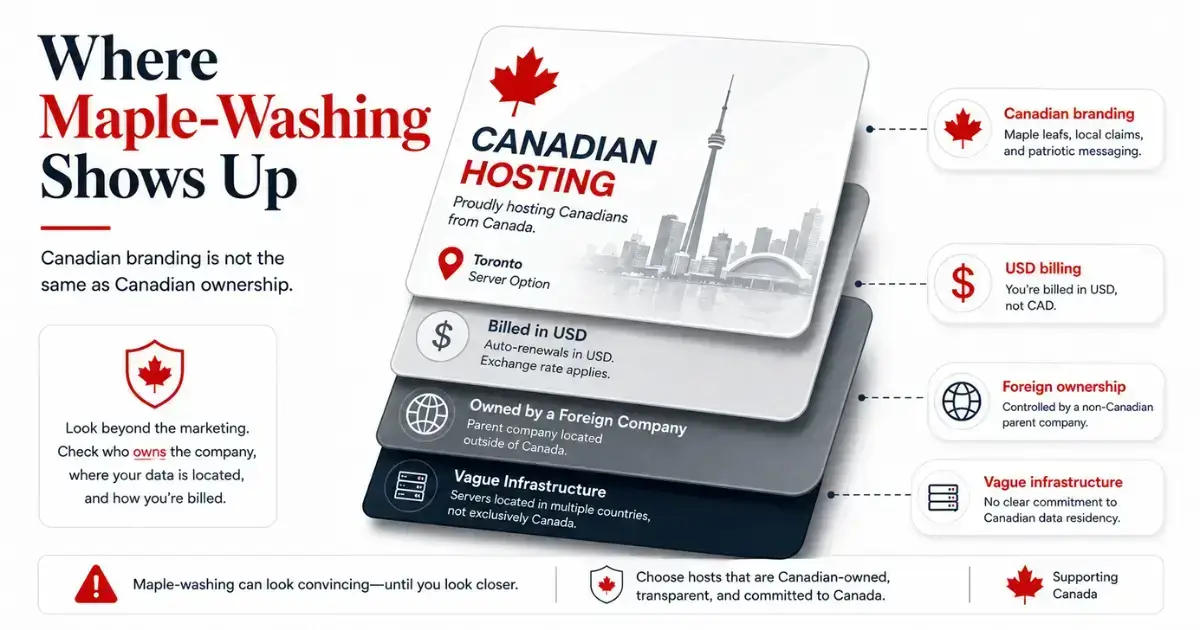
This is where I introduce a term that should be on every Canadian buyer's radar: maple-washing.
Maple-washing is when a non-Canadian hosting company markets itself as Canadian because it offers a Canadian data centre option, a .ca landing page, or maple-leaf imagery, while the company itself is owned, operated, priced, or controlled outside Canada.
Why ownership matters
A Canadian-owned host is a fundamentally different relationship than a Canadian-located server. Ownership determines:
- ●Support policies. Is there a real Canadian on the other end of the chat?
- ●Billing currency. CAD with no FX surprises versus quietly-USD pricing.
- ●Legal jurisdiction. Disputes settled under Canadian law or foreign law.
- ●Acquisition risk. Will this brand still exist in 5 years, or get bought by EIG?
- ●Data handling practices. PIPEDA-aligned versus ambiguous foreign processing.
- ●Transparency. Do they publish a real Canadian address and data centre map?
The Maple-Washing Playbook
Here are the four most common moves foreign hosts use to look Canadian without actually being Canadian. Watch for them.
The "Toronto Server" Trick
A global company offers a Toronto data centre option as one of 30 regions. They're not Canadian, but they'll happily put your files in Canada for an extra fee.
The "Canada Landing Page" Trick
A host builds Canadian SEO pages, runs Google Ads on "Canadian hosting", and uses a .ca subdomain, while still billing in USD and operating from elsewhere.
The "Canadian Flag Everywhere" Trick
Maple leaves in the logo, "Eh!" in the marketing copy, a hockey jersey on the about page. Visual branding does not prove ownership, server location, or data handling.
The "Prices Look Cheap Until Checkout" Trick
$2.99 listed price, in USD. The actual CAD bill is closer to $4.50 after FX, and renewal jumps to $11 USD next year. Always check the fine print and the currency.
Server Location and Data Residency: Where Does the Website Actually Live?
The Office of the Privacy Commissioner of Canada says organizations remain accountable for personal information even when it is outsourced to third-party providers. PIPEDA does not ban cross-border processing, but businesses must take reasonable steps to protect personal information handled by third parties.
For Canadian businesses, the simplest way to take "reasonable steps" is to host on Canadian soil with a Canadian-owned provider.
Why Canadian server location matters
- ●Lower latency for Canadian visitors
- ●Cleaner data residency story for procurement and privacy reviews
- ●Easier privacy due diligence when working with regulated industries
- ●Better fit for Canadian clients in healthcare, legal, and finance
- ●Transparent procurement for agencies and government contracts
Server location isn't always easy to prove
A simple IP lookup can be misleading. Things that fool basic checks:
- ●Cloudflare or another CDN may hide the origin server
- ●DNS may point to a proxy, not the actual host
- ●The public IP may belong to a CDN edge, not the actual host
- ●Backups may be stored in a different region
- ●Email, analytics, forms, and file uploads may use separate services
Use the HostFinder Canada Host Checker for an instant answer, or run a proper traceroute to see the network path. Combined with a WHOIS lookup, you'll see who owns the IP block and where it was allocated.
Don't forget about backups
Generic hosting articles forget this. Backups are data too, and they often live in different regions for redundancy. Before you sign with a host, ask them where each of these is stored:
-
Website files (the primary storage)
-
Databases (customer records, order history)
-
Snapshots (daily or weekly point-in-time copies)
-
Object storage (uploaded images, documents, media)
-
Email backups (often hosted separately)
-
Disaster recovery copies (off-site redundancy)
The Legal "Made in Canada" Test
There's a regulatory angle here that most hosting articles ignore. The Competition Bureau of Canada strictly enforces laws against false or misleading "Made in Canada" or "Product of Canada" claims.
The Bureau says it evaluates the "general impression conveyed to a consumer." If a website uses a .ca domain, waves a maple leaf, and claims to be a "100% Canadian platform," but outsources its servers, data storage, and payment processing to the United States, it is creating a false general impression.
The same logic that protects shoppers from misleading product labels protects them from misleading website claims. As a Canadian consumer, you have a real basis to expect a "100% Canadian" website to actually operate on Canadian infrastructure.
My Real-World Developer Standard
As a Canadian developer who has worked on dozens of websites for Canadian businesses, I do not judge a website by the flag in the hero image. I look at the boring technical and business details:
- ●What does DNS resolve to?
- ●Where does the IP geolocate?
- ●Who owns the hosting provider?
- ●What currency is billing in?
- ●Where are backups stored?
- ●Does the host clearly explain where customer data is stored?
I've seen too many "Canadian-branded" websites where a quick DNS check revealed a US-based SaaS platform behind everything. Toronto law firms with customer files sitting on AWS us-east-1. Local boutiques quietly billed in USD. Healthcare practices unaware their booking software stored patient names in Virginia.
That's why I built HostFinder.ca with stricter inclusion standards than most hosting directories. A host doesn't earn a spot by being "available in Canada." A host earns a spot by being Canadian-owned, Canadian-operated, Canadian-hosted, and CAD-billed.
HostFinder.ca's Standard for "Canadian Hosting"
Here is the criteria every host on HostFinder.ca must meet before they're listed:
Canadian-Owned
The company is genuinely Canadian-owned, not just using Canadian marketing language.
Canadian-Operated
Support, operations, and business presence have a real Canadian connection.
Canadian Infrastructure
Servers or core hosting infrastructure are physically located in Canada.
CAD Billing
Pricing is in Canadian dollars, so users avoid surprise exchange rates and FX fees.
Transparent Provider Information
The provider clearly discloses ownership, infrastructure, pricing, and support details.
Your Canadian Website Checklist
Here's a practical checklist you can use when evaluating any hosting provider or auditing your own site. A website is more genuinely Canadian when:
-
The domain is a
.caor clearly targets Canada -
The business or website owner has a real Canadian presence
-
The hosting company is Canadian-owned
-
The hosting company is Canadian-operated
-
The servers are physically located in Canada
-
Backups and disaster recovery locations are clearly disclosed
-
Pricing is in CAD with no FX surprises
-
Support is available during Canadian business hours
-
The provider doesn't hide behind vague "North American" infrastructure language
-
The company is transparent about ownership, addresses, and data centre locations
A Truly Canadian Website Is More Than a .CA Domain
Let me summarize the distinction in one place:
- ●A .ca domain proves Canadian Presence Requirements
- ●A Canadian business proves the site owner has a Canadian connection
- ●A Canadian-owned host proves the provider has Canadian ownership
- ●A Canadian server location proves data residency and improves performance
- ●CAD billing protects Canadian customers from currency surprises
Before choosing a host, check more than the logo, flag, or domain extension. Look at ownership, infrastructure, billing currency, and where your data actually lives.
Find a host that passes all four layers
Every host listed on HostFinder.ca is Canadian-owned, Canadian-operated, runs on Canadian servers, and bills in CAD. No maple-washing, no Toronto-as-a-region tricks.