
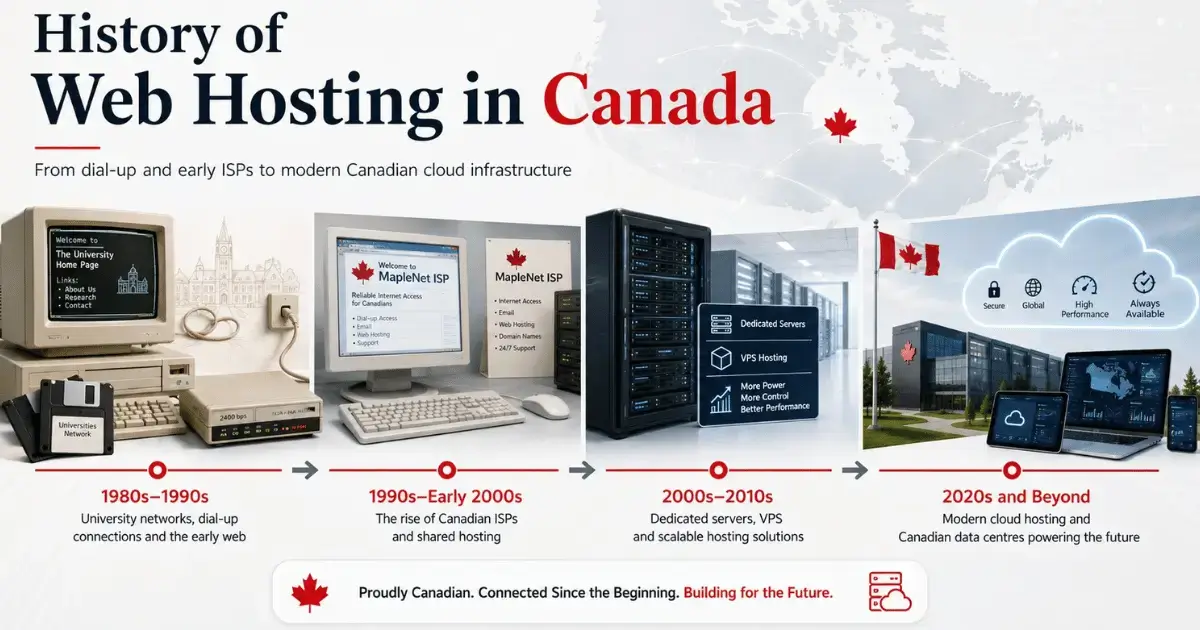
When people talk about the history of web hosting in Canada, they usually jump straight to cloud servers and modern data centres. But Canadian web hosting didn't begin there. It grew out of university networks, early internet experiments, dial-up service, and the first commercial ISPs that gave Canadians a doorway to the web.
In the beginning, "hosting" wasn't a separate industry. Many early Canadian websites lived on academic machines, company servers, or the small slice of web space that came with an internet account. Over time, that grew into shared hosting, dedicated servers, VPS, managed hosting, and cloud platforms that scale in minutes.
This is the story of a Canadian industry that started by piggybacking on American networks, struggled with expensive bandwidth through the 1990s, found its identity through privacy laws in the 2000s, and is now a $20.9 billion sector powered by our cold climate and green hydroelectric grids.
Quick Timeline: Four Decades of Canadian Hosting
The Networks That Came First
To understand web hosting in Canada, you have to go back before the web was mainstream. In the 1980s, Canadian universities were already linking computers through research networks.
According to CANARIE's history of Canada's early internet, universities across the country used a network called NetNorth before Canada moved toward TCP/IP, the protocol that became the foundation of the modern internet.
That move led to a new national network, CA*net, which first operated at 56 Kbps. This wasn't "web hosting" in the business sense. It was basic internet infrastructure for email, file transfer, and research traffic. Still, it laid the groundwork for what came later.
CANARIE still operates Canada's national research and education network today, now running at speeds over 100,000 times faster than that original 56 Kbps link.
The handoff from academic to commercial internet
By 1994, the web started to change everything. CANARIE notes that the arrival of the World Wide Web and Netscape caused traffic to grow quickly. By 1997, commercial networks could handle regular internet services, and CA*net began to wind down as the private sector took over.
That handoff is a key part of the story. Before businesses could buy hosting plans, Canada needed:
- ●Stable internet infrastructure across the country
- ●Shared technical standards
- ●Organizations capable of connecting networks coast to coast
- ●A regulatory environment that allowed commercial ISPs to operate
The 1990s: ISP Boom and Early Hosting
The 1990s were the true beginning of public internet life in Canada. This is when hosting transitioned from university basements to commercial enterprises, and when the first ISPs brought the web into homes and small businesses.
For most Canadians, the first experience was a dial-up connection over a phone line. Statistics Canada later described dial-up as the first widespread method of internet access during the 1990s.
The Rise of CAIP (1996)
As dial-up ISPs popped up across the country, the Canadian Association of Internet Providers (CAIP) was founded in 1996 to organize the industry. At this point, "hosting" usually just meant your local ISP giving you a few megabytes of space on their server to put up a basic HTML page.
The Bandwidth Bottleneck
In the late 1990s, the biggest challenge for Canadian hosting was bandwidth cost. Because so much internet traffic was routed through the United States, Canadian hosts were at a pricing disadvantage compared to massive American competitors like GeoCities and Angelfire.
This shaped a generation of Canadian businesses: many built their websites on US hosting because it was simply cheaper. The trade-off, faster but more expensive Canadian hosting versus cheaper but slower US hosting, is one that still shapes the market today.
What hosting looked like back then
In those years, hosting was basic. A typical user got:
- ●An email account on the ISP's mail server
- ●A small amount of web space (5 to 20 MB was common)
- ●FTP access for uploading files
- ●Maybe a simple guestbook or hit counter CGI script
For personal users, that was enough. Early business websites were brochure sites with contact details, business hours, and a few service pages.
How the .CA Domain Shaped Canadian Hosting
No history of web hosting in Canada is complete without the .CA domain. Hosting and domains are different services, but they grew together. A Canadian website usually needed both a place to live and a local web identity.
The volunteer years (1987 to 2000)
According to the University of British Columbia's profile of John Demco, Demco registered .CA in May 1987 and managed the registry on a volunteer basis from UBC for years. By January 1988, ubc.ca had been registered.
The CIRA era (2000 to today)
CIRA's official history notes that:
- ●1987 to 2000: UBC volunteers managed the .CA registry
- ●1998: CIRA was incorporated as the official registry organization
- ●2000: CIRA officially took over management of .CA
- ●Today: CIRA manages over 3 million .CA domains
This mattered for hosting because it made Canadian web identity easier to manage at scale. It gave businesses more confidence in building around a Canadian domain and supported the growth of registrars, web hosts, and digital agencies.
Important myth to bust: A .CA domain does not mean Canadian hosting. A company can use a .CA domain while hosting its site in the US, Germany, or anywhere else. Domains show identity. Hosting shows where the service actually runs. Learn how to check where your site is actually hosted →
The 2000s: Broadband and the Rise of E-Commerce
In the 2000s, Canadian web hosting moved from "nice to have" to "business essential."
Statistics Canada reported that in 2000, 51% of Canadian households had at least one regular internet user, up from 42% in 1999. Online shopping was growing quickly. Another Statistics Canada release found Canadian households placed 9.1 million online orders in 2000, spending about $1.1 billion.
Canadian data centres become serious
This is the period when Canadian data centres became much more important. Instead of hosting on a basic ISP account, businesses started buying proper hosting plans from specialist providers. Shared hosting remained the entry point, but the market diversified into:
- ●Managed hosting for businesses without in-house IT
- ●Reseller hosting for agencies and freelancers
- ●Dedicated servers for high-traffic sites
- ●Colocation for businesses with their own hardware
Not every Canadian website was actually hosted in Canada, though. For years, many Canadian businesses used US hosting because it was cheaper or easier to scale. That tradeoff still shapes the Canadian hosting market today.
The 2010s: Virtualization, VPS, and Cloud
The next major change wasn't just faster internet. It was a different way of thinking about servers.
Virtualization changes everything
Virtualization let providers split one physical machine into many isolated environments. That made VPS hosting practical, improved server efficiency, and lowered the cost of giving customers more control.
For Canadian businesses, it created a middle ground between cheap shared hosting and expensive dedicated servers. A VPS gave you root access, guaranteed resources, better isolation, and pricing in the $20 to $80 CAD range instead of $200+.
Canada Builds Its Own Network Backbone
This was also the decade when network design became part of the hosting conversation. CIRA explains that Canadian Internet Exchange Points (IXPs) make the internet faster, cheaper, and more resilient by letting Canadian networks connect at Canadian hubs instead of routing through US infrastructure.
Today, Canada has 24 Internet Exchange Points operating across 11 cities, from Vancouver to Halifax. Each one is a physical location where networks meet and swap traffic locally, cutting out the long-haul trip across the border.
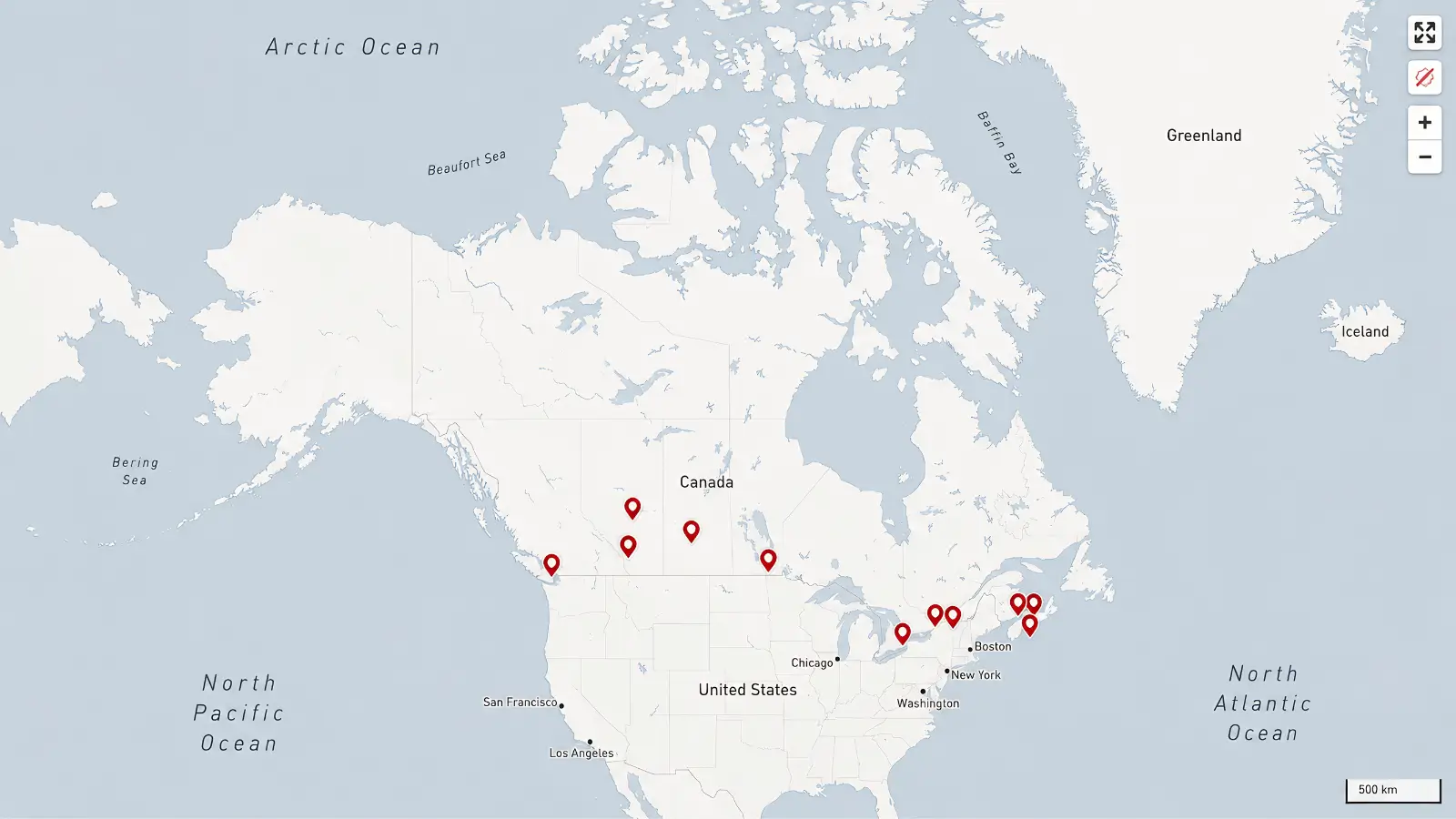
In theory, that infrastructure should mean Canadian websites stay on Canadian networks. In practice, the picture is messier.
The 64% Problem
In a 2016 study by CIRA and Packet Clearing House, the data revealed something startling about Canadian internet routing:
Where Canadian-to-Canadian traffic actually goes
A "Canadian" site can be slower, less private, and less resilient when its traffic routes through Chicago or Ashburn. This is why Canadian IXPs matter so much: every additional exchange point pulls more domestic traffic back onto Canadian networks.
The Cloud Era and Hyperscale Growth (2020s)
Today, Canadian hosting is less about rack space in a closet and more about massive, power-hungry cloud infrastructure. Statistics Canada reported that cloud computing was the most commonly used ICT among Canadian businesses in 2023, with 48% of businesses using it. In the information and cultural industries sector, the figure jumped to 81%.
From $7.9B to $20.9B in five years
Statistics Canada tracks the "computing infrastructure providers, data processing, web hosting, and related services" industry. The growth trajectory tells the cloud story better than any anecdote:
The shift to digital and cloud subscriptions
Statistics Canada data also perfectly illustrates the shift from older, manual hosting contracts to modern, instant cloud deployments. In 2024, 55.3% of all sales in the web hosting and computing infrastructure sector were conducted via e-commerce transactions, up from 49.7% the year before.
Why Canada Became a Global Hosting Hub
Three structural advantages turned Canada from a bandwidth-disadvantaged outpost in the 1990s into a target for hyperscale investment in the 2020s.
According to market research, the Canadian data centre market was valued at USD 17.31 billion in 2024 and is projected to reach USD 42.76 billion by 2030 (15.22% annual growth). Microsoft committed USD 500 million for Quebec cloud expansion in 2024. AWS opened its second Canadian region in Calgary backed by USD 17.9 billion in investment.
Canadian winters dramatically reduce server cooling costs, the single biggest energy expense at scale. Free outside air cooling cuts operating bills by 30 to 50% versus US southern climates.
Quebec, BC, and Manitoba run on abundant, cheap, low-carbon hydro. Quebec's industrial power rates are roughly half what they are in California.
PIPEDA and Quebec's Law 25 make Canada attractive to businesses with data residency requirements. Many EU firms route Canadian operations through here for legal certainty.
AWS, Azure, and Google Cloud all run multiple Canadian regions. Toronto, Montreal, and Calgary now offer hyperscale capacity equivalent to any major US metro.
The combination is unusual globally. Few countries offer cheap green power, cold weather, political stability, and strong privacy law in the same package. Statistics Canada confirms cloud is now the most-used ICT in Canadian business.
Canadian Cloud Regions Today
All three hyperscale public cloud platforms now operate multiple Canadian regions:
That doesn't mean every workload belongs on hyperscale cloud. Small businesses are often better served by Canadian-owned hosting companies like FullHost, Web Hosting Canada, and PlanetHoster. But it does mean Canadian organizations have more domestic options than ever before.
Why Local Hosting in Canada Matters More Now
In the early web, local infrastructure was helpful but not always critical. Websites were lighter, privacy debates were less mature, and many businesses were just happy to be online.
That's no longer true. Modern websites process payments, store user data, connect to CRMs, sync apps, stream media, and support real-time features. Local Canadian infrastructure matters far more than it did in the 1990s or early 2000s.
1. Speed and latency expectations
Users now expect fast load times, especially on mobile. Round-trip time from a Toronto user to a Toronto server is roughly half what it is to a Virginia server, and a third of what it is to Frankfurt.
2. Privacy and PIPEDA
The Office of the Privacy Commissioner of Canada explains PIPEDA's requirements, and its cloud computing FAQ makes an important point: PIPEDA doesn't ban foreign cloud use, but organizations remain responsible for protecting personal information and being transparent about how it's handled.
3. Network resilience
CIRA's work on IXPs and network resilience shows why domestic interconnection matters. If local traffic exchanges locally, the internet is faster, cheaper, and more robust against outages.
4. National connectivity as policy
The Government of Canada's stated goal is universal access to high-speed internet at 50 Mbps download and 10 Mbps upload. As of 2023, 96.3% of Canadian households had access to that minimum, with a target of 98% by 2026.
Hosting in Canada is now part of a broader national conversation about connectivity, resilience, and digital competitiveness.
What Canadian Businesses Should Look For Today
The history of web hosting in Canada leads to a simple conclusion: choosing hosting is a strategic decision, not just a technical checkbox.
-
Where are the servers? A Canadian audience usually benefits from Canadian data centre locations.
-
Where are the backups stored? Primary hosting in Canada doesn't help much if backups live elsewhere.
-
What type of hosting is it? Shared, VPS, managed cloud, and dedicated all solve different problems.
-
How does traffic move? Ask about peering, CDN strategy, and IXP participation.
-
What are the privacy implications? Especially if you handle personal or sensitive data.
-
How easy is it to scale? Modern websites often need room to grow fast.
-
Is support local? Time zone alignment and Canadian context still matter.
-
Are they actually Canadian-owned? "Branded as Canadian" and "Canadian-owned" aren't the same thing.
Three things that get confused
Don't confuse these. They can overlap, but they're not the same:
You can have any combination. The one that matters most for performance, privacy, and compliance is the third. Check where your site is actually hosted if you're not sure.
Key Lessons From the History of Canadian Web Hosting
- ●The Canadian hosting market grew out of research networking and early ISPs, not from scratch
- ●Dial-up access and bundled web space introduced most Canadians to web hosting
- ●The .CA domain helped build a trusted Canadian web identity but doesn't guarantee Canadian hosting
- ●Broadband and e-commerce turned hosting from a hobby into a core business service
- ●Virtualization and cloud changed hosting from a fixed product into a flexible platform
- ●Cold climate and green hydroelectric power made Canada a global hyperscale destination
- ●The industry grew to $20.9 billion by 2024, with cloud transactions now over half of all sales
The story of web hosting in Canada is really the story of the Canadian internet growing up. It started with research networks and volunteer-driven systems. It moved through dial-up, broadband, professional hosting, virtualization, and finally cloud.
In the early days, getting online was the hard part. Today, the hard part is making smart infrastructure choices.
That's why local hosting in Canada matters more now than it did in the early web. Speed, data handling, network paths, resilience, and user trust all matter more than they used to. For Canadian businesses, web hosting is no longer just a place to store files. It's part of your performance, privacy posture, customer experience, and long-term digital strategy.
Choosing a Canadian Host in 2026
If you're choosing a host today, start with our research-backed comparison of Canadian providers, or use the free Host Checker tool to verify where your current site actually lives.